Voicebot vs Chatbot: What is the Difference?
A Voicebot is an AI-powered system that uses voice recognition and NLP to interact with customers through spoken language, ideal for phone-based and hands-free interactions. A Chatbot communicates via text on websites, apps, or messaging platforms, making it ideal for digital, asynchronous, and FAQ-type interactions. Both use NLP and machine learning, but serve fundamentally different customer interaction contexts. DialDesk supports both as part of a unified AI customer service platform.
Why the Voicebot vs Chatbot Decision Matters for Your Business?
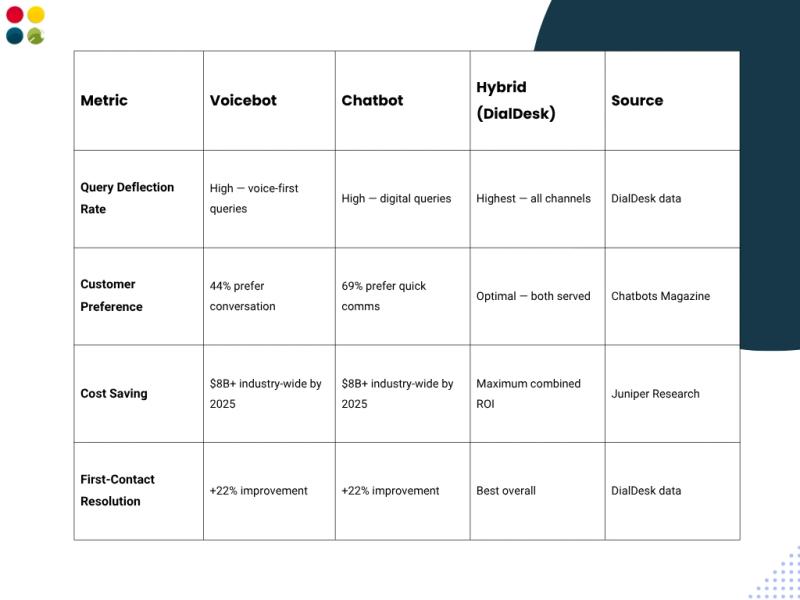
By 2025, AI-powered chatbots are forecast to save businesses more than $8 billion annually, while Voicebot technology will handle approximately 20% of all global customer interactions (Juniper Research). Both technologies are now mainstream. But choosing the wrong one, or deploying it in the wrong context, actively frustrates customers rather than helping them.
Understanding the precise differences between Voicebot vs Chatbot is the foundation for every smart AI customer service investment. This guide cuts through the noise to give you the clear, comparative picture you need.
Why It Matters
69% of customers prefer chatbots for quick communication, while 44% enjoy voicebots for their conversational experience (Chatbots Magazine survey). Neither wins outright; the right choice depends entirely on your customer's context and your business model.
Voicebot vs Chatbot: The Core Differences at a Glance
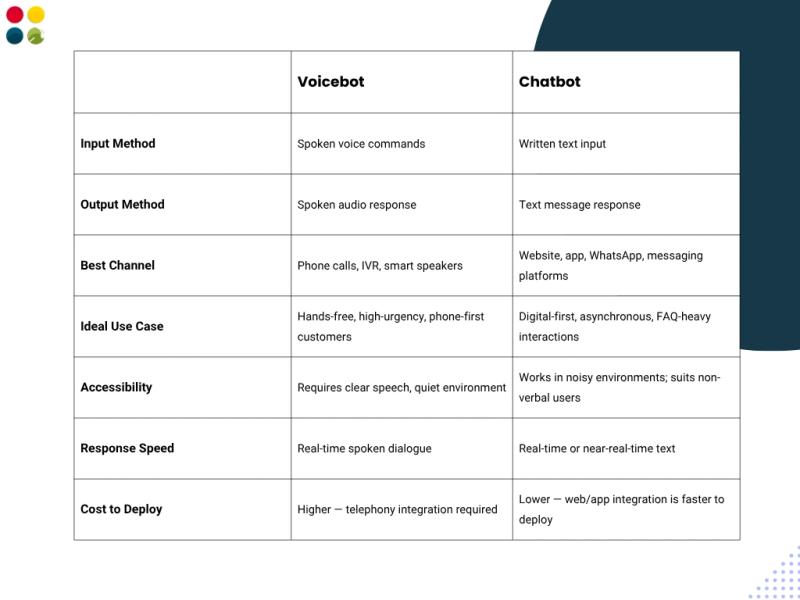
What is a Voicebot and When Should You Use One?
A Voicebot is an AI system that uses speech recognition, NLP, and text-to-speech synthesis to conduct natural spoken conversations with customers. It is the technology behind intelligent IVR systems, voice-based self-service platforms, and AI-assisted inbound call handling.
Voicebots are the right choice when:
• Your customers predominantly interact via phone — healthcare, banking, insurance, and telecom are classic examples.
• You need to reduce call waiting times and automate Tier-1 query resolution at scale.
• Hands-free accessibility is critical for customers driving, cooking, or managing mobility challenges.
• You want to deploy intelligent IVR and call routing that understands natural language, not just keypad input.
What is a Chatbot and When Should You Use One?
A Chatbot is an AI system that communicates through text on digital channels — websites, mobile apps, WhatsApp, Facebook Messenger, and live chat platforms. It handles structured queries, guides customers through processes, and escalates complex issues to human agents seamlessly.
Chatbots are the right choice when:
• Your customers interact primarily through digital channels — e-commerce, SaaS, and media brands are typical examples.
• You need 24/7 FAQ resolution, order tracking, and account management without human agent overhead.
• You serve customers in noisy environments where voice is impractical, or users who prefer typing to speaking.
• You want to deflect high-volume repetitive queries and reduce inbound contact centre load.
The Four Scenarios Where Voicebot vs Chatbot Choice is Critical
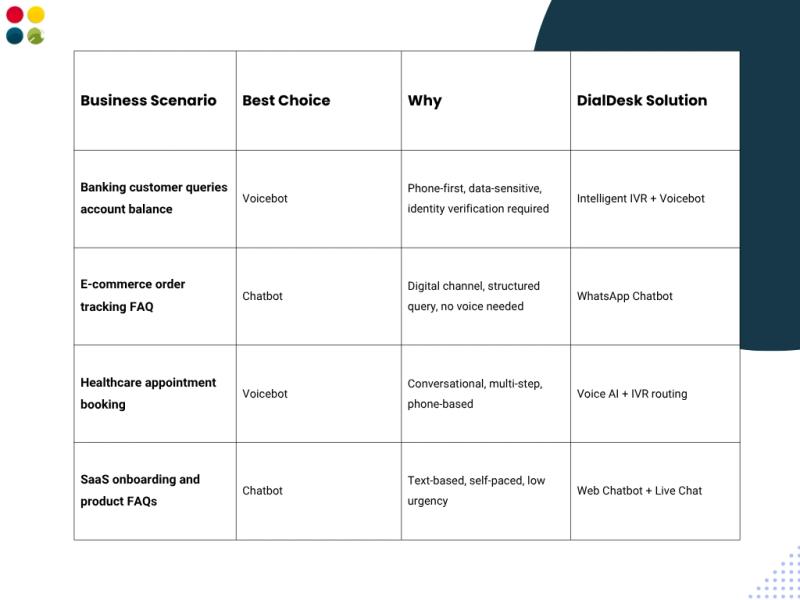
The Hybrid Model: Voicebot and Chatbot Working Together
Voicebot vs Chatbot is often a false choice. The most effective AI customer service deployments use both, with intelligent handoff logic that ensures customers are always in the right channel at the right moment.
Example in action: A travel company deploys a Chatbot on its website to handle destination searches and package queries. When a customer needs to complete a booking with payment confirmation and specific itinerary details, they are seamlessly escalated to a Voicebot or a human agent, with full context preserved. No repetition. No frustration.
Business Impact: Voicebot vs Chatbot — Performance Benchmarks
✅ Trusted by 500+ Contact Centers Across India
DialDesk's Voicebot and Chatbot platforms are ISO 9001:2015 and ISO 27001:2013 certified, enterprise-grade AI customer service built for India's contact centre environment. Explore our full call center software India platform.
Key Takeaways
• Chatbot vs Voicebot is not a competition; both serve distinct customer interaction contexts with equal effectiveness.
• Voicebots are optimal for phone-first, hands-free, conversational interactions, particularly in healthcare, banking, and telecom.
• Chatbots excel in digital channels — website, WhatsApp, app — for FAQ resolution and 24/7 asynchronous support.
• The hybrid model, deploying both with intelligent handoff, delivers the highest customer satisfaction and deflection rates.
• 69% of customers prefer chatbots for speed; 44% prefer voicebots for conversation quality, both serve real customer needs.
• DialDesk supports both on a single unified platform, ensuring consistent CX quality across every channel.
Conclusion
The Voicebot vs Chatbot question has a clear answer: both are valuable, and the most effective businesses deploy both strategically. The real competitive advantage lies in understanding which technology serves your customers' preferred interaction style, and building a unified platform that transitions seamlessly between them.
The customer service brands winning in 2025 are not the ones that have picked a side. They are the ones that have built a hybrid conversational AI strategy — Voicebot for voice, Chatbot for digital, and intelligent escalation to human agents when either reaches its limit.
Explore how DialDesk's platform integrates Voicebot and Chatbot capabilities with your IVR and call routing and cloud telephony India stack, delivering unified conversational AI from day one.
Right channel. Right moment. Right outcome. DialDesk delivers all three.
✅ Trusted Signal: DialDesk's Certifications
ISO 9001:2015 (Quality Management) · ISO 27001:2013 (Information Security) · Deployed across Healthcare, Banking, Retail, Telecom, and FMCG verticals in India.
📅 Want to Deploy Voicebot, Chatbot, or Both?
DialDesk's unified conversational AI platform deploys Voicebot and Chatbot capabilities on a single intelligence engine, giving your customers the right interaction experience on every channel. Join 500+ contact centres across India already transforming CX with DialDesk.