What Is the Inbound Voice Process?
The Inbound Voice Process is a structured BPO workflow where customer calls are received, routed through an IVR system, connected to the right agent, resolved in real time, and logged for quality assurance. DialDesk’s AI-powered Inbound Voice Process adds real-time sentiment analysis, live coaching prompts, and automated escalation across every call.
Why Understanding the Inbound Voice Process Matters Today
The BPO Inbound Process is the operational heartbeat of every contact center. It determines how fast customers resolve, how efficiently agents handle volume, and how reliably satisfaction scores reflect reality.
Yet most teams treat the Inbound Voice Process as a fixed workflow, a static series of steps that have not changed in a decade. Today, that approach is a competitive liability. AI now supports every stage of the inbound call workflow, from intelligent routing to real-time emotion detection, helping teams cut escalations and resolve more issues on the first call.
💡 Why It Matters
Contact centers that modernise their BPO Inbound Process with AI-driven routing and real-time analytics can handle more calls without adding headcount, while improving customer satisfaction.
What Does Inbound Process Mean: The Definition
Inbound Process Means: An Inbound Process in BPO refers to a contact center operation where customer-initiated contacts, calls, chats, WhatsApp messages, or emails are received, triaged, routed, and resolved by trained agents supported by technology. Unlike outbound campaigns where agents initiate contact, the Inbound Voice Process is reactive: the customer calls; the system and agent respond.
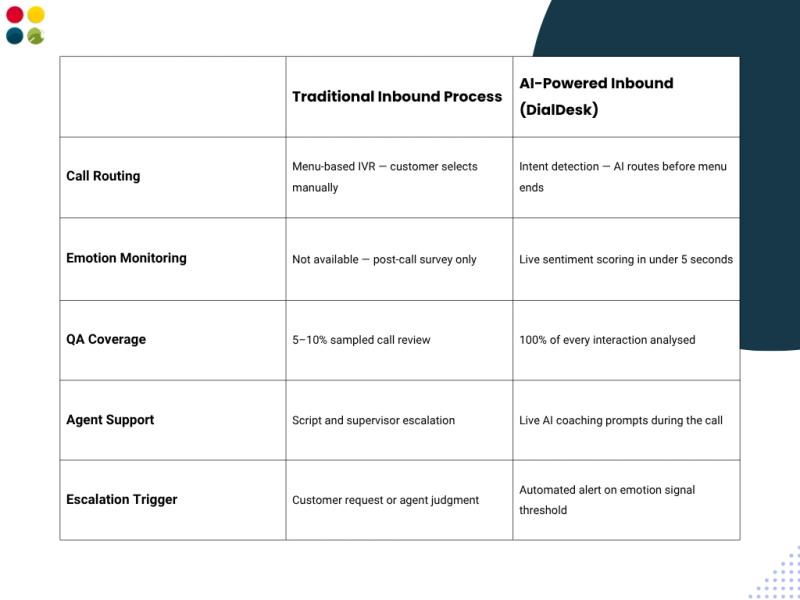
What Makes AI-Powered Inbound Voice Different from Traditional Workflows
The BPO Inbound Process: Step-by-Step Breakdown
Understanding how the Inbound Voice Process works in full, from dial to close, is essential for optimising every touchpoint.
Step 1 — Customer Initiates Contact
The customer dials the contact center number, sends a WhatsApp message, or initiates a chat. In DialDesk’s platform, all channels are unified; every interaction enters the same workflow regardless of channel.
Step 2 — IVR Triage and Intent Detection
The Inbound Process routes the contact through an IVR system. In traditional BPO Inbound Process workflows, the customer manually selects from a menu. DialDesk’s AI detects intent from natural speech, routing the caller to the right queue before the menu completes.
Step 3 — Queue Management and Priority Scoring
Once in queue, calls are prioritised by customer tier, issue type, and, in AI-powered systems, emotional state. A caller showing escalating frustration is surfaced ahead of routine queries, reducing escalation risk before the agent answers.
Step 4 — Agent Connection and Live Support
The call connects to the right agent with a screen pop of the customer’s history, previous interaction summaries, and AI-generated context. DialDesk provides the agent with a live sentiment score and coaching prompts throughout the conversation.
Step 5 — Resolution, Wrap-Up, and Documentation
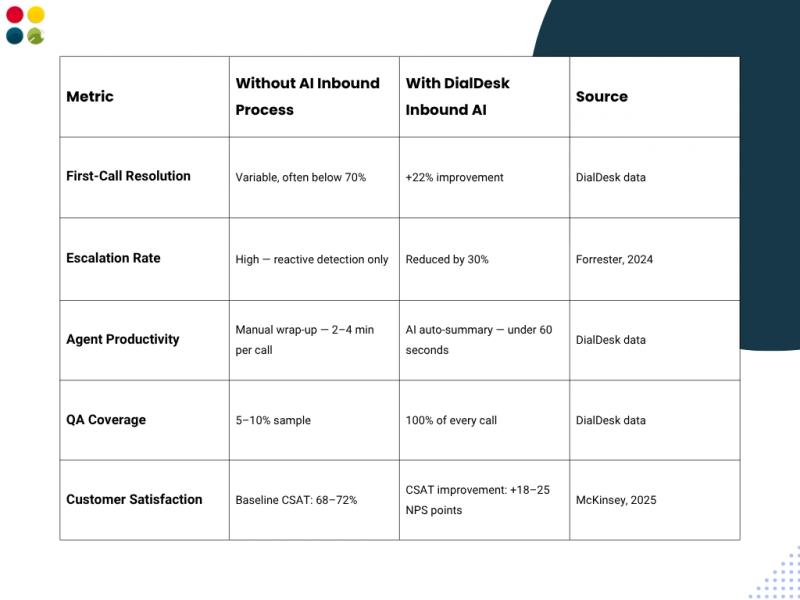
At the call end, the agent documents the resolution. DialDesk auto-generates call summaries, tags the interaction by category and sentiment, and flags any unresolved issues for follow-up, eliminating manual wrap-up delay.
Step 6 — Quality Assurance and Feedback Loop
In a traditional Inbound Process, QA reviews only a small sample of calls, often days later. DialDesk analyses interactions in real time, delivering actionable coaching data to supervisors within the same shift.
Business Impact: The Numbers Behind Inbound Voice Optimisation
✅ Trusted by 250+ Clients Across India
DialDesk is ISO 9001:2015 and ISO/IEC 27001:2022 certified — enterprise-grade BPO technology built for India’s contact center environment. See our full call center software India platform.
Key Takeaways
• The Inbound Voice Process is a multi-step workflow, from customer dial to resolution, that determines CX quality, agent efficiency, and satisfaction outcomes.
• Inbound Process means a customer-initiated contact workflow; BPO Inbound Process is the structured, agent-supported version used in outsourced contact centers.
• AI transforms every stage: intent-based routing, real-time sentiment scoring, live coaching prompts, and wider QA coverage replace manual, sampled, reactive approaches.
• DialDesk processes inbound signals in real time, enabling live intervention, not retrospective review.
• Modernising the BPO Inbound Process helps raise first-call resolution and reduce escalations.
Conclusion
The Inbound Voice Process is not just a call flow; it is the foundation of every customer relationship your contact center builds or breaks. How calls are routed, how agents are supported, and how interactions are analysed determines whether customers feel heard or ignored.
The BPO Inbound Process has evolved. Manual IVR, sampled QA, and delayed coaching are no longer sufficient in a market where customers compare every call to their best service experience, regardless of industry.
Explore how DialDesk’s Inbound Voice Process platform connects with your IVR and call routing, cloud telephony India stack, and AI sentiment analysis tools to transform every inbound interaction from a transaction into a loyalty opportunity.
Every call is a moment. DialDesk makes every moment count.
📅 Want to Modernise Your Inbound Voice Process?
DialDesk’s AI-powered BPO Inbound Process platform handles routing, sentiment analysis, agent coaching, and QA across your interactions - voice, WhatsApp, and chat - in real time. Join 250+ clients across India who trust DialDesk with their customer operations.