OVERVIEW
● This blog breaks down the real differences between Onshore Customer Service, Nearshore Customer Service, and Offshore Customer Service-not in theory, but how companies experience them today.
● We will discuss costs, talent pools, scalability, time zones, cultural fit, and digital transformation challenges.
● You will also get real data, expert-level insights, an infographic for comparison, and practical guidance to choose the right model.
Introduction
Customer service is evolving at a pace faster than most businesses are ready for. Teams that once considered local agents sufficient are now looking to explore nearshore hubs, offshore talent, hybrid teams, and even AI-enabled contact centers.
But here’s the nuance many blogs miss:
You don’t choose onshore vs nearshore vs offshore because one is “better.”
You choose based on operational maturity, customer expectations, and the stage of your business. A startup hungry for cost efficiency might lean towards offshore talent.
Nearshore might be selected for a global brand requiring multilingual, culturally aligned agents.
Onshore Customer Service might be required by a licensed enterprise for compliance and customer trust. In 2025, it’s all about location, location, location.
It’s about agility, customer experience quality, tech-stack readiness, AI integration, and cost-risk balance.
And that’s exactly what this guide helps you decode.
What Each Model Really Means (Without the Fluff)
1. Onshore Customer Service
Customer service is provided from the same country where the business is based.
Best for: Regulated industries, premium brands, companies requiring deep cultural context.
Why it works:
● Strong compliance alignment
● Zero language/cultural barriers
● Faster training + smoother collaboration
2025 stat: 86% of customers believe interactions are more “trustworthy” when working with onshore teams (Source: Zendesk CX Report 2024).
2. Nearshore Customer Service
Customer service from nearby countries or similar time zones.
Best for: Fast-scaling companies need affordable yet high-quality agents.
Why it works:
● Closer time zone alignment = smoother real-time collaboration
● Better cultural proximity than offshore
● 20–35% lower cost than onshore (Deloitte Global Outsourcing Study 2024)
2025 trend: Nearshore adoption rose 41% in the last two years, especially for multilingual support hubs.
3. Offshore Customer Service
Customer service is delivered from distant countries with major cost advantages.
Best for: Large ticket volumes, cost-focused teams, multilingual global support.
Why it works:
● Most affordable outsourcing model
● Deep, mature talent pools (India, Philippines)
● 24/7 operations possible at scale
Stat: Offshore outsourcing decreases operational costs by up to 70% according to the McKinsey Global Services Report 2023.
Onshore vs Nearshore vs Offshore (Quick Comparison)
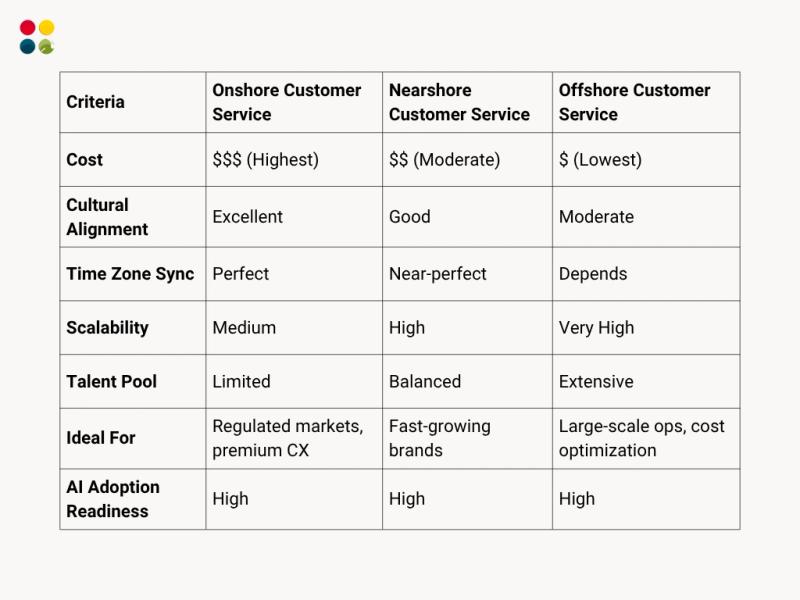
Deep-Dive: Choosing the Right Model Based on Your Business Reality
1. If CX is your brand differentiator → Onshore or Nearshore
Luxury, healthcare, fintech, and legal industries often require:
✔ Contextual knowledge ✔ High customer trust ✔ Strong compliance handling
For such industries, even a 5-second hesitation by an agent can break confidence.
If you want the safest choice, choose onshore.
If you want balance, choose Nearshore Customer Service.
2. If your priority is cost + 24/7 coverage → Offshore wins
Offshore teams excel when:
● Volume is high
● Cost sensitivity is real
● AI + human blended workflows will be required.
The Everest Group BPO Study indicates that by 2026, 65% of global BPO talent will be supplied from offshore locations.
3. If you operate globally → Mix nearshore + offshore
This hybrid is expected to be the most popular model in 2025.
Why?
You get cost efficiency, cultural alignment, and multilingual capability.
The smartest brands don’t pick one model—they build tiered support.
4. If your main bottleneck is training speed → Nearshore
Nearshore markets often have similar learning styles, cultural references, and operational frameworks to your country.
Training cycles decrease by 30–50%, therefore decreasing overall ramp-up time.
5. If your brand relies heavily on voice support → Cultural fit is king
Voice performance metrics are better when the accent and tonal patterns are closer to the caller’s expectations.
Nearshore > Onshore > Offshore (for accent clarity)
But Offshore > Nearshore > Onshore (for cost, scale, and flexibility)
It’s all about your brand’s priorities.
Thoughts to Ponder
● Are you basing your outsourcing location selection on data or assumptions?
● Is cost-cutting today costing you customer satisfaction tomorrow?
● Would a Hybrid Support model be better than a single-location strategy for your team?
● Are your CX challenges operational, or are they structural?
● How will AI automation change your outsourcing model over the next 2 years?
Key Takeaways
● There is no “best” model, only the best fit for your business stage and CX maturity.
● Onshore = trust + compliance, Nearshore = balance + speed, Offshore = scale + cost efficiency.
● Hybrid models now outperform single-location setups.
● Customer expectations for 2025 call for cultural alignment and affordability.
● AI is making offshore teams more capable than ever, but human-led CX still requires contextual understanding.
Wrap Up
Outsourcing Customer Service isn’t about moving ops; it’s about redefining how a brand scales, differentiates, and earns trust.
As global CX matures, the smartest companies don’t choose based on cost alone.
They choose a model that strengthens customer loyalty, operational flexibility, and long-term profitability.
Conclusion
Whether you’re leaning toward Onshore, Nearshore, or Offshore Customer Service, your decision should start with one question:
What kind of customer experience does your brand want to deliver today and two years in the future?
With the right partner and the right model, you don’t just support customers…
You create a competitive advantage.
Looking for the perfect customer service setup for your brand?
DialDesk helps companies build onshore, nearshore, offshore, and hybrid support teams powered by AI, analytics, and real human expertise.
Let’s build customer experiences your customers remember.